Stardust Cookie Cutter
A browser extension that solves cookie consent pop-ups automatically.
- Type of work
- Product design, Front-end development
- Year
- 2020–2022
- Platform
- Browser
A team of three built Stardust Cookie Cutter as a translation layer between people and the websites they visit. I led product design and front-end development.
20k+
Users across 5 browsers
30k+
Hours of clicking through consent banners saved

Context
88.2% of consent pop-ups do not meet EU legal requirements (Nouwens et al., CHI 2020). Every site asks differently, so people never know what a click will do and end up accepting to make the banner go away.
Estonia’s digital state runs on a once only principle: you never have to give the same information twice. We applied the same idea to the web.
Problem
Insight
What if a person could set their preferences once and have them applied on every website? Stardust works as a translation layer between the user and the website.
88.2%
Of consent pop-ups do not meet EU legal requirements, leaving users frustrated at unpredictable banners (Nouwens et al., CHI 2020).
Decisions
Discovery started in 2020 with a personal data wallet, which won the Garage48 Cybersecurity hackathon. We narrowed it to consents and prototyped rule-based logic that answers consent platforms such as OneTrust and Cookiebot on the user’s behalf, later combined with AI.
Focus on consents only
The wallet also covered email aliases, autofill and payments. Research pointed to one daily pain, so we cut everything else and built for that alone.
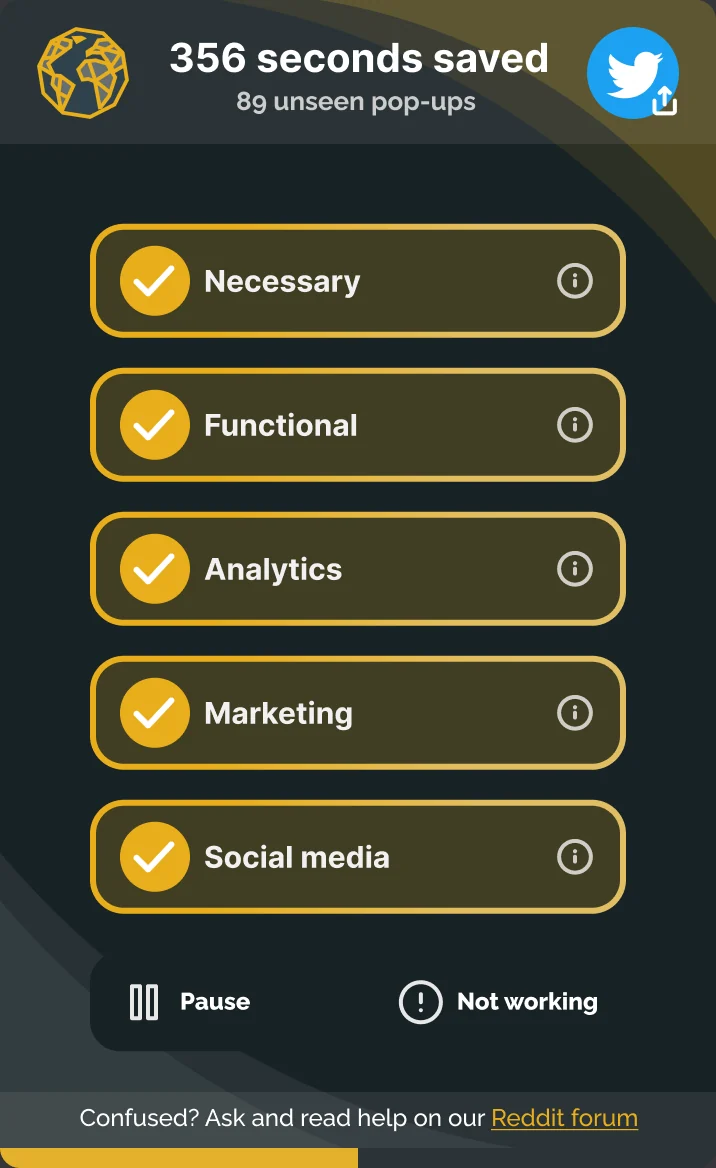
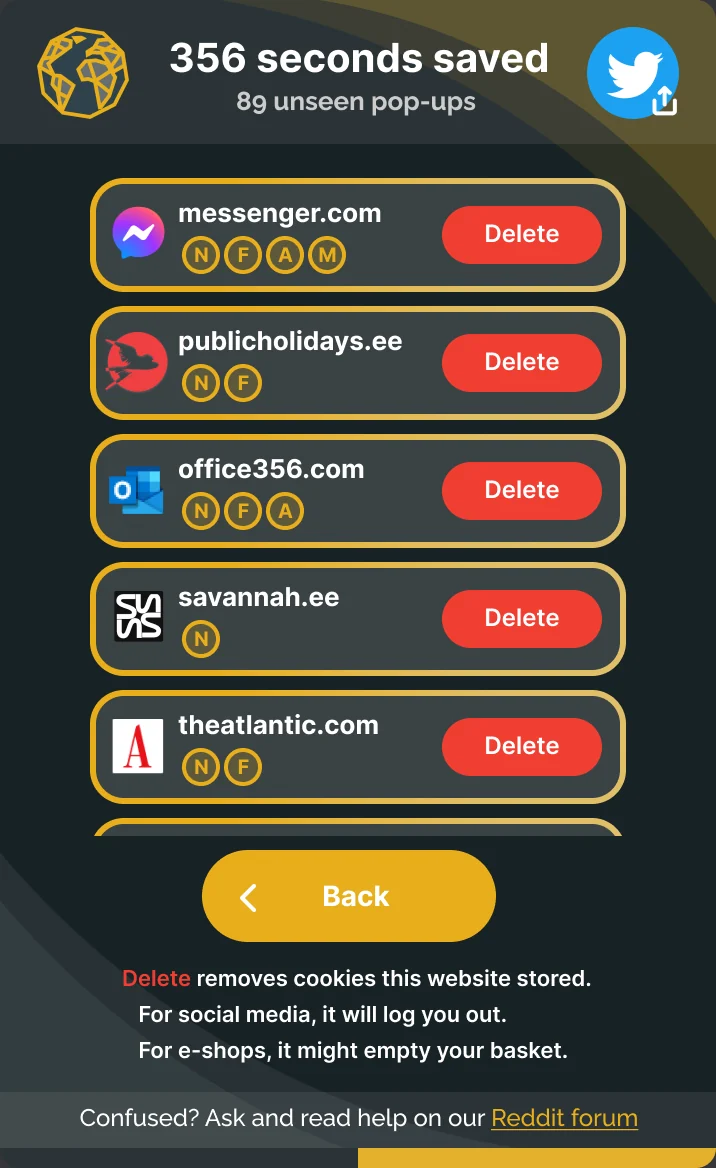
Preferences-based extension view
The popup leads with the user’s own preferences as a short list of toggles, with a count of banners answered below. People open it to check that it works, and the count answers that at a glance.
Interactions on mobile
When Safari opened to extensions on iOS, our desktop toast covered content on a phone. We replaced it with a subtle border animation around the viewport and added onboarding for Safari permissions.
Design
Most of the craft went into two small surfaces: the popup, a few hundred pixels wide, and the signal that consents were applied, which had to reassure people without interrupting their reading.
Impact
It kept working after we stopped
20k+
Users across 5 browsers
30k+
Hours of clicking saved
2,000
People still using it each month
1st
Place at the Garage48 Cybersecurity hackathon
“Sometimes the best products are those not visible at all.”
“Works great almost all the time and has a report button for when it goes a little bit wrong so you can help improve it. Excellent.”
“Pretty handy. Before I’d just click accept to all the tracking stuff to save time, whereas now I can set this extension to opt-out automatically.”
Reflection
One thing, done really well
The product became popular because it did one thing really well. Sometimes the best products are those not visible at all.
We could not validate a business model and eventually had to move on. In November 2025 the European Commission proposed that sites must respect consent signals set once in the browser, which is in essence what Stardust shipped back in 2021.
Epilogue
The wallet, revisited
Firn carried the personal data wallet into one-tap donations for news sites. Readers keep a small balance in the extension and tap a heart to support the articles they value.